Agentic AI and the Future of Innovation Management
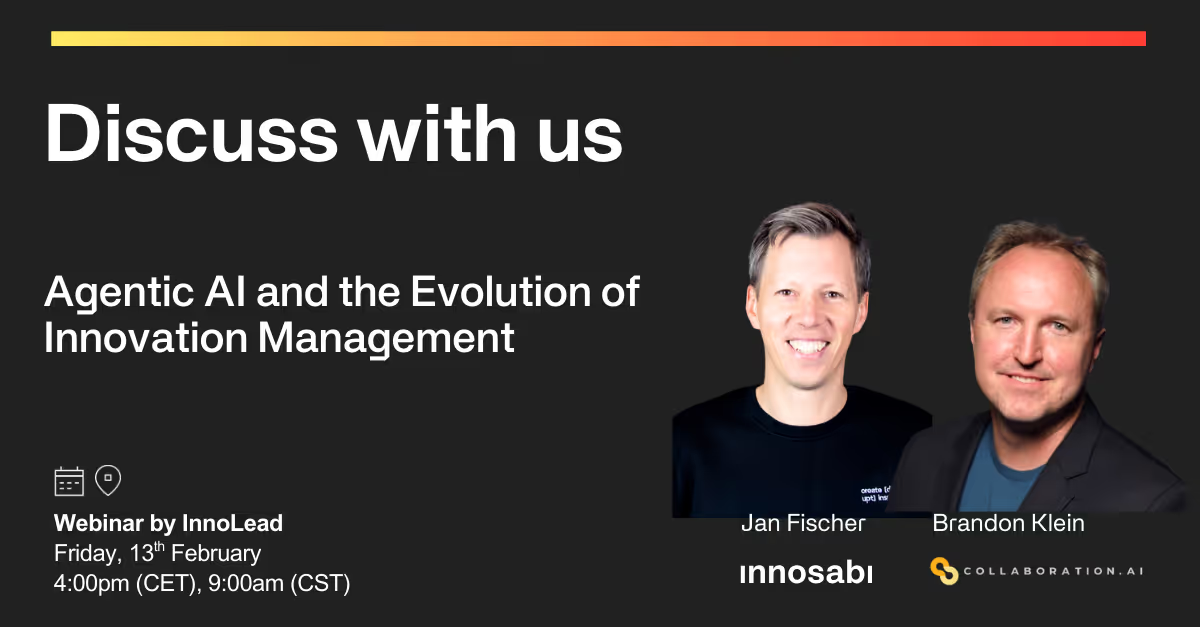



Innovation management is entering a new phase.
For years, digital platforms helped organizations collect ideas, structure workflows, and manage portfolios. AI added efficiency: faster clustering, smarter search, automated summaries.
Now a deeper shift is underway.
Agentic AI is not just accelerating existing processes. It is changing how innovation systems are designed, governed, and scaled inside large enterprises.
We believe that this is not a tooling upgrade. It is a structural transformation.
Below are five strategic dimensions innovation leaders must understand to navigate this shift.
Large enterprises have traditionally separated innovation and transformation.
Innovation teams explored new products, services, and business models.
Transformation teams reshaped culture, processes, and digital capabilities.
In practice, both relied on similar mechanisms:
The difference was not the system. It was the objective. With agentic AI, that distinction begins to dissolve.
When AI continuously evaluates opportunity spaces, simulates scenarios, and supports capital allocation, innovation becomes embedded in the transformation engine itself. The system does not merely capture ideas. It actively guides investment decisions.
Traditional innovation platforms track:
With an agentic AI layer on top, the platform evolves into something more powerful: A continuously learning investment engine.
It analyzes signals across markets, internal projects, external ecosystems, and operational data. It supports smarter capital allocation. It reduces bias. It increases transparency.
The implication is significant.
Innovation leaders move from managing stage gates to orchestrating intelligent capital deployment. They become relationship architects between strategy, finance, engineering, and operations.
Innovation and transformation are no longer parallel tracks. They converge in the design of an adaptive enterprise system.
There is little debate that AI increases productivity. It accelerates research cycles, enhances insight generation, and improves decision quality. The question is not whether AI is a force multiplier. It clearly is.
The real question is whether organizations can govern that multiplier.
In regulated industries especially, unbounded experimentation is not an option. Agentic AI must operate within clearly defined enterprise constraints. It must be auditable, transparent, and aligned with strategic KPIs. It must respect access rights, compliance structures, and portfolio governance models already in place.
Enterprise-grade AI differs fundamentally from consumer AI. It cannot function as an opaque black box. Its logic, data sources, and decision paths must be understandable.
At the same time, the greatest strategic risk may not be AI itself, but poorly framed human questions. If organizations scale flawed assumptions, they amplify error. If they use AI to pressure-test hypotheses, simulate scenarios, and refine strategic inquiry, they dramatically improve decision quality.
Agentic AI, in this sense, becomes a decision simulator. It shifts humans from operators of processes to designers of intelligent systems.
Every productivity revolution in history has reshaped roles rather than eliminated value creation. The same pattern is emerging here. The multiplier is neutral. Governance determines whether it becomes a competitive advantage or systemic risk.
We at innosabi together with Collaboration.AI have proven that our systems, technology and consulting has the highest governance standard when working successfully together with NASA or U.S. Air and Space Forces.
“Garbage in, garbage out” remains a valid concern. Innovation deals with ambiguity, weak signals, and incomplete data. Human accountability cannot disappear.
But constant manual oversight does not scale.
The emerging model is governed autonomy. Instead of placing guardrails outside the system, organizations embed them within it. Agents operate within defined parameters. Data access is controlled. Behavior is transparent. Escalation paths are predefined.
Just as innovation management matured through standardized methodologies, agentic AI will require validated agent frameworks. Organizations will define and refine trusted configurations for clustering ideas, scouting technologies, simulating portfolio scenarios, and evaluating capital efficiency.
Governed autonomy does not mean removing humans from the loop. It means designing systems where autonomy operates within enterprise constraints. Innovation does not slow down, but it does not lose accountability either.
The balance between control and flexibility becomes a design challenge rather than a political one.
Open innovation has long been fragmented. Internal idea programs, startup scouting, supplier collaboration, and university partnerships were typically managed as distinct initiatives. Each required manual orchestration, significant coordination, and heavy governance.
Agentic AI changes the scale equation.
It can analyze thousands of startups, map external capabilities against internal projects, detect complementary technologies, and surface partnership hypotheses at machine speed. The boundary between inside and outside innovation begins to dissolve.
Open innovation becomes systemic rather than episodic.
Instead of running isolated campaigns, organizations orchestrate a dynamic ecosystem. Ideas flow across corporate boundaries. Agents detect complementarities faster than any human team could. The innovation ecosystem becomes fluid and composable.
For large enterprises, this marks a transition from managing programs to managing networks - where the power of Collaboration.AI and its product NetworkOS lives.
Perhaps the most compelling moment of the conversation was Jan’s example of the blue collar worker.
A frontline employee identifies a mechanical improvement. Using AI, he narrows material options to three viable candidates before engaging engineering.
The engineer still validates the decision.
But the ideation threshold has dropped dramatically.
Agentic AI lowers the barrier to participation.
Distributed innovation is no longer a slogan. It becomes operational reality.
Innovation leaders can now detect entrepreneurial friction in real time.
For highly educated innovation managers in large enterprises, the implications are strategic:
The core capability shifts from managing ideas to designing intelligent systems.
The organizations that succeed will not simply deploy AI tools. They will architect governed, modular, composable innovation ecosystems with agents embedded at every layer.
Agentic AI does not eliminate the role of innovation leadership. It raises it.
Innovation managers become:
In short, the future of innovation management is not about replacing human judgment.
It is about augmenting it with continuously learning systems that operate at a scale no human team ever could.
And as the LinkedIn Live made clear, we are still at the beginning of defining that playground.
The question is no longer whether agentic AI will shape innovation.
The question is whether your organization will design that system intentionally.


