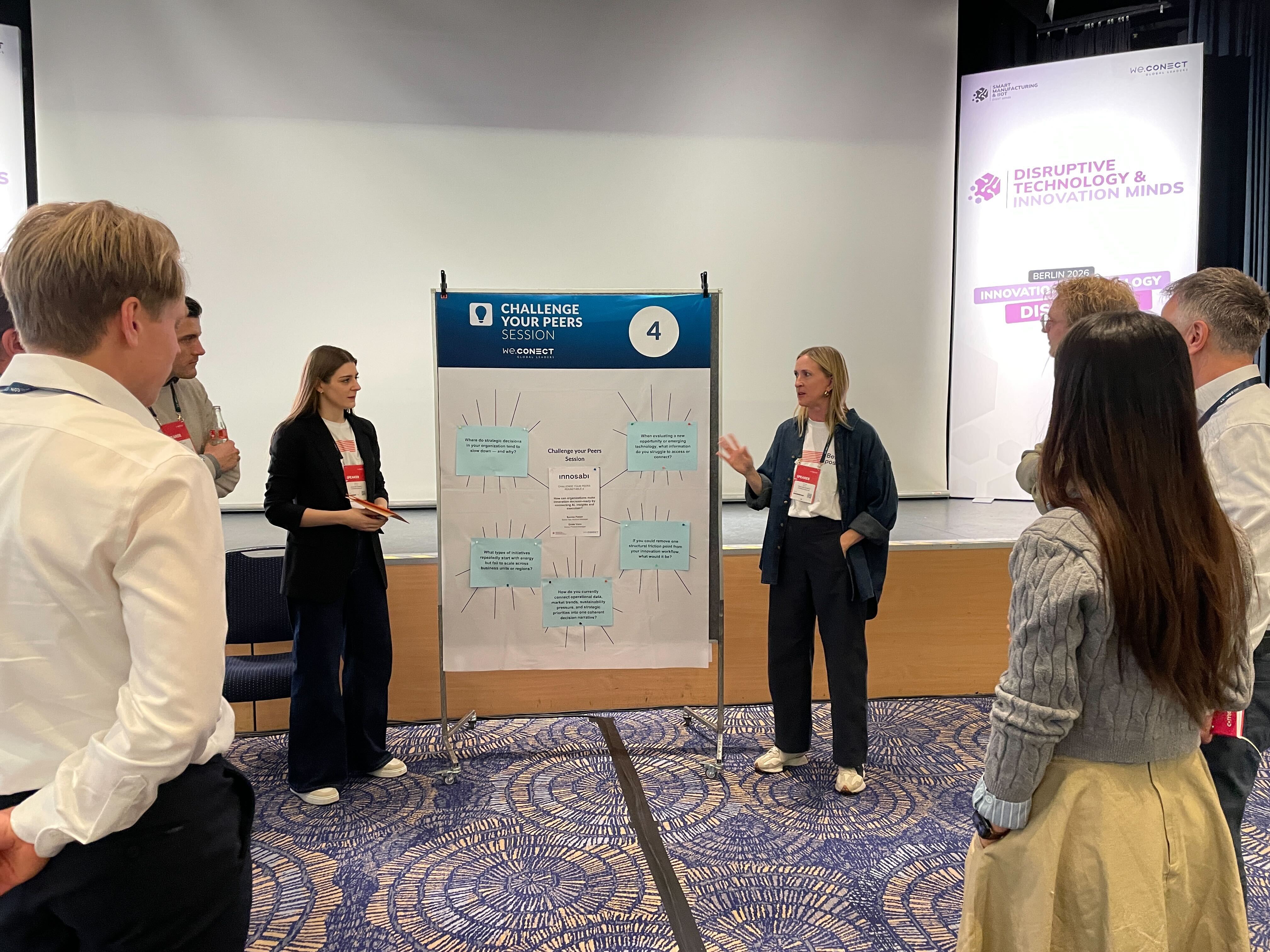
Berlin, April 2026. Forty innovation leaders sat down at DTIM — no slides, no pitches. Just peers telling peers what's actually broken in their organizations. The format was simple. The answers were not.
The session was co-facilitated by Greta Vann from our team at Collaboration.Ai. Greta isn't a typical product manager. She's trained in strategy, fluent in data, and has spent years doing frontline innovation work before building the tools that support it. That combination matters. When someone says "we struggle with cross-functional alignment," a consultant writes it down. Someone who's lived in those gaps knows the follow-up question that cracks the real answer open.
01 · the method
Why peer confession works when surveys don't
Surveys get you what people think they should say. A roundtable, facilitated by someone who's been in the same seat, gets you what they'd actually tell a friend at dinner.
The structure was deliberate. Each question was designed to hit a different organizational nerve. Not "what's your strategy?" but "where does the strategy stop working?"
1
Ask a question that sounds safe but isn't. "Where do strategic decisions slow down?" sounds like process mapping. It's actually about power.
2
Let the first answer be polished. Don't react. Wait. The second and third answers from the room are the real ones.
3
Name the pattern in real time. "Three of you just said the same thing in different words." That's when the room shifts.
02 · confession one
Where strategic decisions actually die
We asked: "Where do strategic decisions in your organization tend to slow down, and why?"
The corporate answer is "alignment takes time." The real answer is that nobody has permission to say yes.
Click each card to see what they actually said.
The slide deck version
"We need better alignment between innovation and executive teams on strategic priorities."
Click to flip →
What they actually said
"There's no commitment from C-level. Decisions stall or reverse without warning."
Peer roundtable, Berlin 2026
Click to flip back →
The slide deck version
"Cross-functional collaboration could be improved to accelerate execution."
Click to flip →
What they actually said
"Nobody owns the handoff. Ideas exist. Translation into action is completely absent."
Peer roundtable, Berlin 2026
Click to flip back →
The slide deck version
"Innovation culture requires organizational commitment and incentive design."
Click to flip →
What they actually said
"There are zero incentives for innovation participation. Daily business always wins."
Peer roundtable, Berlin 2026
Click to flip back →
The slide deck version
"We're working to foster a growth mindset and reduce risk aversion in our teams."
Click to flip →
What they actually said
"Perfectionist mindset and fear of failure. That's the real strategy. Don't ship anything that might be wrong."
Peer roundtable, Berlin 2026
Click to flip back →
Four confessions, one theme. The decision architecture is broken. Not the people. Not the ideas. The organizational wiring that's supposed to turn a "yes" into an outcome was never built. Most innovation programs were installed on top of a company that wasn't restructured to support them.
03 · confession two
The data that should connect, doesn't
We asked: "When evaluating a new opportunity or emerging technology, what information do you struggle to access or connect?"
This one hit a nerve fast. The room didn't talk about missing data. They talked about data that exists in six places and belongs to nobody.
Click each card to see what they actually said.
The slide deck version
"We're investing in data infrastructure to improve cross-functional visibility."
Click to flip →
What they actually said
"Data is scattered across systems and it's often low quality. Nobody aggregates it."
Peer roundtable, Berlin 2026
Click to flip back →
The slide deck version
"Customer insights are integrated into our innovation pipeline through structured feedback loops."
Click to flip →
What they actually said
"Customer feedback is impossible to access early in the cycle. By the time we get it, the decision's already made."
Peer roundtable, Berlin 2026
Click to flip back →
The slide deck version
"We're building a business case framework to improve ROI visibility on innovation investments."
Click to flip →
What they actually said
"The cost and ROI perspective is missing entirely. We can't justify decisions because we can't measure what happened."
Peer roundtable, Berlin 2026
Click to flip back →
The slide deck version
"Our talent strategy supports data-driven decision-making across the innovation lifecycle."
Click to flip →
What they actually said
"We don't have the data quality or the talent to make it work consistently. Success is luck, not system."
Peer roundtable, Berlin 2026
Click to flip back →
The problem isn't missing data. It's that data gets collected for a single process, not for the organization. Every department has its own reporting stack, its own definitions, its own timeline. Innovation sits on top of all of them and inherits every inconsistency.
A dashboard doesn't fix this. What fixes it is giving the innovation function the same data gravity that finance has: one source, one cadence, one place where the truth lives.
04 · confession three
What starts with energy and dies at the border
We asked: "What types of initiatives repeatedly start with energy but fail to scale across business units or regions?"
This is where the room got honest about the gap between a pilot and an outcome. The energy isn't the problem. The walls between units are.
Click each card to see what they actually said.
The slide deck version
"We're refining our scaling framework to support multi-region rollouts of successful pilots."
Click to flip →
What they actually said
"Initiatives succeed regionally but can't scale globally. Translating both linguistically and operationally breaks every time."
Peer roundtable, Berlin 2026
Click to flip back →
The slide deck version
"Resource allocation is being optimized to support innovation at scale."
Click to flip →
What they actually said
"There's no scope definition, no resources, and the distance to real market adoption feels impossibly large."
Peer roundtable, Berlin 2026
Click to flip back →
The slide deck version
"Budget cycles are being aligned with innovation timelines through improved planning processes."
Click to flip →
What they actually said
"Budget planning cycles and innovation timelines don't match. By the time you get funding, the opportunity's gone."
Peer roundtable, Berlin 2026
Click to flip back →
The slide deck version
"We're evaluating technology relevance through structured assessment frameworks."
Click to flip →
What they actually said
"Nobody can tell us if a technology connects to the core business or the future business. We need scenario planning before we commit."
Peer roundtable, Berlin 2026
Click to flip back →
The scaling problem isn't a mystery. It's a timing problem, a translation problem, and a resources problem — all at once. The pilot works because one person cared enough to push it through. The scaled version fails because the organization's rhythms don't carry it.
Budget runs on a 12-month cycle. Innovation runs on a signal cycle. Those two clocks never sync by accident. Somebody has to build the bridge.
05 · the pattern
Every confession pointed to the same missing piece
Read the confessions again. Strip away the industry differences, the company size, the region.
What's left is one thing: no shared operating rhythm.
The finding
The decisions stall because there's no regular moment where the right people look at the same information. The data is scattered because nobody mandated one place where it converges. The pilots don't scale because the handoff between "worked here" and "works everywhere" isn't a meeting, a ritual, or a role. It's a gap.
This doesn't require a reorganization. It doesn't require a new platform. It requires a rhythm.
Five rituals that close the gap
↻
Weekly signal
One digest, shared across functions, same day every week
◎
Joint review
30 minutes, every two weeks, shared scorecard
⟷
Paired brief
Two signatures before any initiative ships
◇
Experiment slot
One in four initiatives is signal-driven, not roadmap-driven
▦
Shared score
Bridge metrics, one page, reviewed monthly
These aren't theoretical. They emerged independently from our research with over 100 companies — and then again, from a completely different starting question, in this room in Berlin. That convergence is the signal.
The gap isn't ideas, tools, or talent. It's the operating rhythm that connects them.